

Comfortable Living Starts with Reliable Hot Water Supply Reliable and fast access to hot water is essential for comfortable living. That is why modern domestic hot water (DHW) systems increasingly rely on plate heat exchangers. These are dependable, compact, and energy-efficient devices that ensure quick and even water heating—both in apartment blocks and private homes.
You can purchase a DHW heat exchanger from us—quickly, cost-effectively, and with a quality guarantee. We carry out prompt thermal engineering calculations, and our in-stock components allow for fast production and delivery.
Why a Heat Exchanger is Essential for Domestic Hot Water
Hot water at home is not a luxury but a basic necessity. The heat exchanger plays a key role in a DHW system: it heats cold water using the thermal energy of a district or boiler house heating fluid—without mixing the two streams. This ensures safety, hygiene, and economic efficiency.
Common Domestic Hot Water Supply Schemes
Heat exchangers are commonly used in the following configurations:
- In apartment buildings, hot water is supplied from a district heating plant or boiler house, where cold water is heated in a plate heat exchanger using thermal water.
- In building basements, heat exchangers heat the cold water to hot water temperature using district heating water.
- In private homes, hot water is generated via a brazed heat exchanger integrated in a dual-circuit boiler.
- More and more often, boilers are used – heating storage tanks with a heating circuit.
Two Main Connection Methods to the Heat Network
The correct selection of a DHW heat exchanger connection scheme significantly affects system performance, stability, and energy efficiency. Based on building characteristics, hot water consumption volume, and thermal load, two primary connection types are used:
- Single-stage parallel connection
- Two-stage mixed connection
- Each has its own use cases, design features, and application guidelines.
Single-Stage DHW Scheme
In a parallel (single-stage) connection, the flow rate of the cooling medium (district heating water) is proportional to the DHW thermal load. This scheme is suitable when the ratio of maximum DHW load to heating load (Q_DHW/Q_heating) is less than 0.2 or greater than 1.0.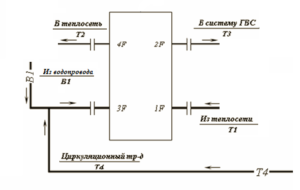
Advantages: Simple implementation and compact design. Disadvantage: Lower energy efficiency under variable consumption conditions.
Two-Stage DHW Scheme
This type of heat exchanger operates efficiently across a wide range of flow rates for both heated and heating media. The two-stage scheme is used when the ratio of the DHW system’s maximum thermal load to the heating system load (Q_DHW / Q_heating) is between 0.2 and 1.
Main advantage: Enhanced energy savings through the reuse of return water from the heating system.
In this scheme, water is heated either in two separate heat exchangers or in a monoblock heat exchanger. The monoblock solution is more economical. While installation is more complex, the system’s overall efficiency increases.
First-stage heat exchanger preheats cold water using a mixture of two heating flows—one from the heating system and another from the second-stage exchanger.
Second-stage heat exchanger is designed to cool the flow of heating medium from the network down to the heating system’s return water temperature, finalising water heating to the set temperature.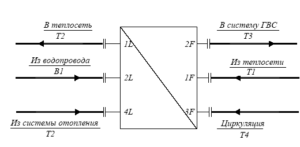
How to Buy a DHW Heat Exchanger
To order a domestic hot water heat exchanger from us, simply fill out a short questionnaire and send it to our specialists. We will quickly select the most suitable model and offer a competitive price tailored to all technical specifications and project requirements.
Last Updated on by Микола Фролкин