
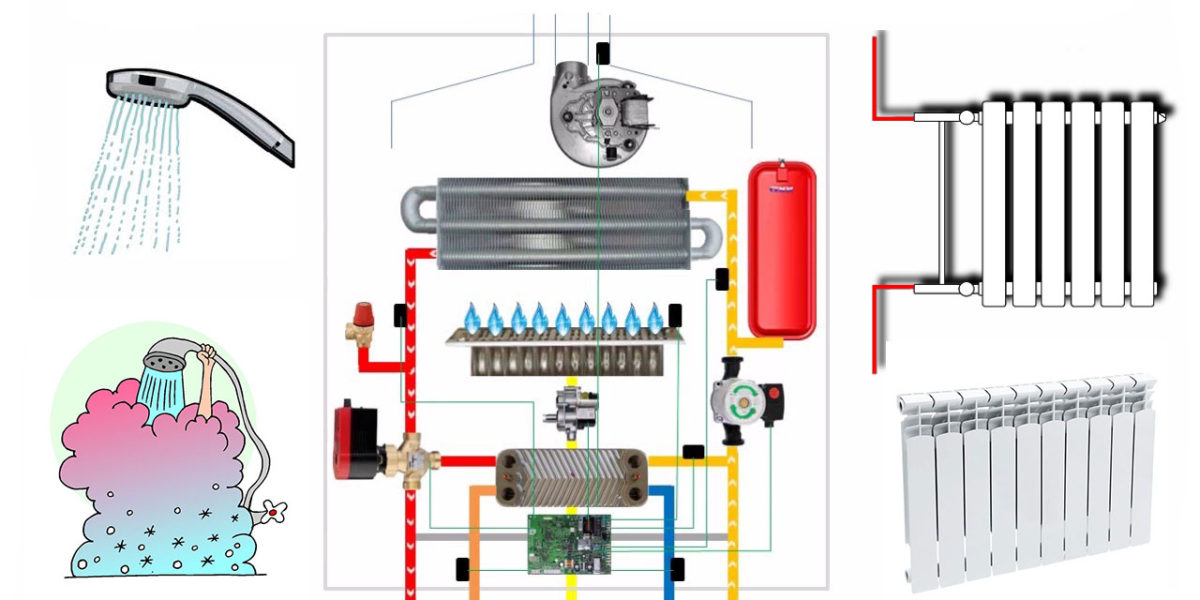
All models, which are presented gas boilers, are divided into two large groups – single-circuit and two-circuit. Two-circuit gas boilers heat water for both heating and DHW. They have two circuits – one for heating and the other for supplying hot water used for sanitary needs.They can have two heat exchangers or one heat exchanger. Single-circuit gas boilers work for heating only the heating system.
Principle of operation of a two-circuit gas boiler
Each boiler manufacturer has its own design of the internal stuffing of the described equipment. But they have one common design solution – two circuits are placed inside the body. The one that is responsible for heating, works on a closed circuit. Water in it circulates in a circle, bypassing all heating points installed in the rooms of the house.
The coolant that moves in a closed circuit does not enter the second circuit. When the water faucets in the kitchen and bathroom are opened, a special valve (three-way valve) cuts off the access of the heating medium to the heating system and directs it to the secondary heat exchanger, which ensures the supply of hot water to the DHW circuit. When the taps in the kitchen or bathroom are closed, the reverse happens.
Two-circuit gas boiler

When starting the gas boiler, the pump is the first to switch on. Then the gas valve starts the gas, which is ignited by the automatic ignition. The burning flame warms the heat exchanger, through which the passing coolant is heated. The heated water is fed into the heating system.
Sensors on the boiler constantly measure the parameters of its operation: the temperature of the supply and return of the coolant, the pressure in the system, gas pressure, the presence of flame and draught.
Regulation of the coolant temperature is made on the supply or on the return. When regulating by return flow, the following happens: the heating system is heated, the temperature sensor sends a signal, the electronic board processes it and gives a command to turn off the gas supply. The circulation pump is not switched off immediately, it will run for a set time (e.g. 30 seconds). This is necessary in order to cool the heat exchanger. If this is not done, the residual heat in the heat exchanger can bring the stopped coolant to boiling point.
After some time, the electronic board will turn the pump back on to see the return temperature. If the water has cooled down, the cycle repeats.
Boiler operation principle for DHW heating
When the tap is opened, cold water runs through the boiler and needs to be heated. The flow sensor is triggered and the board switches the three-way valve to heat the secondary heat exchanger, which in turn heats the water for the consumer. When the faucet is closed, everything happens in reverse order. The flow sensor detected the water cutoff, the board switched the three-way valve to the needs of heating. In two-circuit boilers laid priority DHW. This means that the domestic hot water needs will be served first.
You may have noticed that between opening the tap and getting actual hot water, there is a period of time when the cold water needs to be drained. Some boiler models have a “hot start” feature where the secondary heat exchanger is kept hot, which speeds up getting hot water at the tap. In this case, the board switches the three-way valve to the secondary heat exchanger from time to time.
You canbuy secondary heat exchanger for gas boiler from us. Availability of heat exchangers in stock will ensure their delivery in the shortest possible time. To order a secondary heat exchanger you need to know its dimensions and the number of plates.
Main reasons for lack of heat in the heating system
Possible causes and their elimination:
- blowing out of the heating system. First of all, check if air has accumulated in the radiators, remove air from the system using taps. In order to avoid air blockage, install an air vent at the top of the system.
- clogged batteries. You need to drain the water from the cooled batteries. If you see that the water flows out with debris, and sometimes black sludge can be poured, you need to flush the system until clean water appears;
- Improperly made connections and piping. There may be incorrect pipe diameter, incorrectly installed shutoff valves, incorrectly connected heat exchanger. Check the manufacturer’s recommendations in the manual and correct the mistakes;
- if the pressure is low, the unit also does not heat well. Water must be added to the system;
- Scaling in the heat exchanger. The heat exchanger must be descaled. The use of reagents as additives to the heat transfer medium significantly reduces the formation of scale. But not all models are allowed to use antifreeze. Manufacturers Ariston (Ariston), Arderia (Arderia), Navien (Navien), Buderus, Viessmann (Wiesmann), Electrolux (Electrolux) prohibit the use of antifreeze, recommending the use of distilled water. In the instructions for models Rinnai, Baxi (Baxi), Vaillant (Vaillant), Celtic (Celtic), Ferroli (Ferroli), AOGV 11 6, Beretta (Beretta), Bosch (Bosch), Neva Lux, Protherm (Protherm), Junkers, Koreastar (Koreastar), Daewoo allows the use of antifreeze. However, it should be noted that not any antifreeze is suitable for these boilers.
- Contamination of the heating water filter is also the cause of poor heating of batteries. It is necessary to clean the filter under a strong stream of water, having previously turned off and cooled down the boiler. If the contamination is severe and it cannot be cleaned, replace the filter;
- the heating medium heating temperature is set too low. Increase the temperature on the boiler;
- incorrect operation of the circulation pump. Adjust its flow rate;
- incorrect battery design. The radiators should be matched to the specific heating mode, as each type of radiator has an individual heat output value depending on this mode.
Causes of lack of hot water
The main reason for poor DHW heating is the strong formation of scale inside the heat exchanger, which not only narrows the water flow in the heat exchanger, but also significantly reduces its temperature.
The main way to restore performance is to clean the secondary heat exchanger.
Hot water is not supplied to the faucet when the flow sensor fails to operate. It is a fan that operates when water flows through it. The signal from it goes to the control board, which gives the command to heat the water. The sensor stops working due to clogging. The sensor is a cylinder located near the circulation pump. It can be cleaned without dismantling it. It is necessary to simply open and close the faucet in front of the device. If this procedure did not yield results, it will be necessary to dismantle it, clean it and put it back in its original place.
If the three-way valve is defective, the unit works on the heating system and does not produce hot water. The purpose of the three-way valve is to shut off the heating system and switch to the DHW system when the hot water faucet is opened. When the valve does not switch, the boiler continues to heat water for heating.
The cause of a faulty valve may be a blockage. If the problem is more serious, it is necessary to replace the valve with a new one.
Last Updated on by Микола Фролкин