

A fan coil unit is one of the key components of modern climate control systems. Its popularity is due to a combination of simple design, energy efficiency, and flexible use in both residential and commercial buildings. To understand what a fan coil is and how it works, it’s important to review its structure, operating principle, and application features in real-world conditions.
A fan coil unit is a terminal device in a cooling or heating system that distributes cooled or heated air into the room. It consists of a heat exchanger, a fan, and a control system. A chiller or a heat pump serves as the source of cooling or heat for it.
Thus, a fan coil unit is a universal device that can be used for both cooling and heating air in a room.
Purpose of the device
Fan coil units are used when individual climate control is needed in different zones of a building. For example, in hotels, offices, shopping centers, or apartments with autonomous climate control. Unlike centralized systems, fan coils allow the temperature to be adjusted separately in each room.
History of the fan coil
The history of fan coils began in the mid-20th century, when water-based air conditioning systems were actively developing. Initially, such devices were used in commercial buildings — hotel complexes and administrative centers. The simple operation scheme and modular approach quickly made them a standard in the HVAC (Heating, Ventilation and Air Conditioning) industry.
Today, the fan coil is an essential part of modern climate equipment capable of ensuring comfort in rooms all year round.
Main functions of a fan coil unit
 The functionality of these products goes far beyond conventional air conditioning. A modern water-based fan coil unit can perform several tasks at once, ensuring a comfortable indoor microclimate all year round.
- One of the basic functions of any fan coil is cooling air in summer. Water supplied from the chiller flows through the heat exchanger and absorbs heat from the air passing through the unit. As a result, the room temperature is lowered to a comfortable level. The fan coil also provides even air distribution without strong drafts or cold air bursts.
- Modern heating systems are increasingly replacing traditional radiators with more flexible solutions. A heating fan coil operates on the same principle as cooling — only now hot water from a boiler or heat pump enters the heat exchanger. This makes it possible to use the same unit in both winter and summer without reconfiguring the system.
- In addition to heating and cooling functions, fan coils are equipped with filters that capture dust, pet hair, dirt particles, and other mechanical impurities. Basic filtration is provided by standard mesh filters that are easy to maintain and clean. Some models feature carbon filters or even UV-treatment modules.
Thus, a water-based fan coil is not only an effective way to regulate temperature, but also an air purification element that improves the overall quality of the indoor climate.
Fan coil unit structure
To understand how a fan coil unit works, it’s necessary to examine its internal structure. Regardless of the model and design, every fan coil has a typical structure that combines primary and additional components.
Main components of the unit
A fan coil unit is modular equipment composed of several key components, each performing its function in the process of cooling or heating air. Below is a brief description of the main elements that make up a typical ducted or wall-mounted fan coil unit.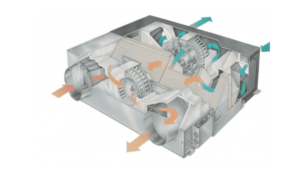
- Heat exchanger — the main working element of the unit. The heat carrier (cooled or heated water) flows through it, supplied from a chiller or boiler. This is where heat transfer occurs from the water to the air or vice versa — depending on the operating mode. The shape and material of the heat exchanger affect efficiency and heat transfer rate.
- Fan — ensures air movement through the heat exchanger. Depending on the model, the fan may be tangential or centrifugal. It creates the required pressure so that air is evenly distributed throughout the room.
- Air filter — traps dust and large particles coming in with the airflow. It is installed before the heat exchanger to protect it from contamination.
- Housing — mechanical protection for all internal components. It may be made of plastic, steel, or galvanized metal. In the case of ducted models, the housing is reinforced and may also be insulated for noise reduction.
- Drainage system — an essential component when operating in cooling mode. Condensate formed on the surface of the heat exchanger is drained through a special tray and drainage pipe.
Additional components (automation, control)
In addition to the basic elements, a modern fan coil may include intelligent control modules that make its operation as accurate and convenient as possible. These components are especially relevant in chiller–fan coil systems.
Among the additional units, the following can be highlighted:
- Thermostats and room controllers — allow setting the desired temperature and operating mode;
- Motorized valves — regulate water supply depending on the thermostat’s signal;
- Humidity and CO₂ sensors — found in premium-class models;
- Programmers and timers — used to automate on/off cycles.
All these options are described in detail in the fan coil manual that comes with each device. The presence of a clear diagram and recommendations for operation allows avoiding errors during setup and prolonging the service life of the equipment.
Fan coil: operating principle
To understand the efficiency and versatility of the device, it’s important to examine how a fan coil works. Its principle is based on a simple yet effective heat exchange between water and air.
How air circulates
A built-in fan draws air from the room, passes it through the heat exchanger, and returns it already cooled or heated. This type of circulation helps maintain an even microclimate.
The fan’s shape and installation type (for example, wall-mounted or ducted) affect the strength and direction of the airflow. With correct installation, the air is evenly distributed, avoiding drafts and areas of overheating or overcooling.
Heat exchange between water and air
The main process takes place inside the heat exchanger, where water circulates — cold or hot depending on the season. During cooling, the fan coil removes heat from the room air and transfers it to the water, and during heating — the opposite.
Operation in different modes (cooling/heating)
A fan coil can operate both in summer and in winter. In cooling mode, water at about 7 °C is supplied to the heat exchanger, and in heating mode — 40–60 °C.
The switch between modes usually happens automatically via the thermostat and control valves.
Types of fan coils
Modern fan coils are classified by numerous criteria: from installation method to structural pipeline features. This allows for optimal solutions tailored to the specific room, architecture, and thermal engineering requirements.
By installation type
The choice of installation depends on the room’s architecture, interior, noise requirements, and installation features. Below are the main types:
Wall-mounted
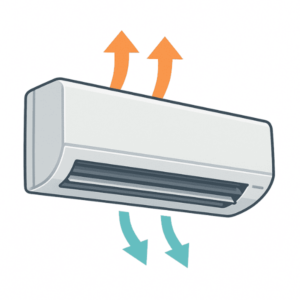
A wall-mounted fan coil externally resembles a split system and is ideal for residential spaces, hotels, and small offices. Wall installation simplifies maintenance and makes the setup as compact as possible.
Floor-mounted
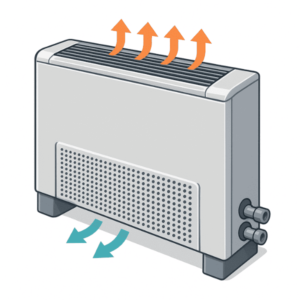
A floor-mounted fan coil is installed directly on the floor or in niches. It is especially convenient when replacing radiators in existing heating systems. Most commonly used in residential buildings and administrative offices with limited ceiling height.
Ceiling-mounted
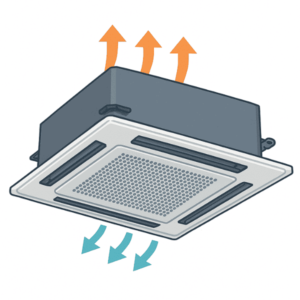
A ceiling-mounted fan coil is installed on the ceiling and directs the air flow downward. It is suitable for rooms with high ceilings, such as halls, shopping areas, or exhibition centers. Often used in open spaces where even air distribution is important.
Cassette
A cassette fan coil is embedded in a suspended ceiling, leaving only the decorative panel visible. Air is distributed in four directions, providing a high level of comfort. This solution is ideal for offices, stores, and rooms with an Armstrong ceiling system.
Ducted
Ducted-type fan coils are installed inside air ducts. They are invisible in the interior and ensure even air distribution, capable of servicing several rooms at once. Often used in business centers and luxury real estate.
By number of pipes
This parameter defines how many circuits (pipes) are connected to the device — and, accordingly, what operation modes can be simultaneous.
Two-pipe
A fan coil with two pipes is a classic scheme where one pipe is for supply and the other for return water. In this configuration, the fan coil can either cool or heat — one at a time.
Four-pipe
A more complex design: two pipes for hot water and two for cold. This allows the same fan coil to simultaneously heat some rooms and cool others. Four-pipe models are most commonly used in commercial buildings, business centers, and facilities where it’s important to maintain independent microclimates in each zone.
Applications
Fan coils are a flexible solution that suits different types of buildings:
- In modern apartments and houses, fan coils are used as an alternative to traditional radiators and split systems. Compact solutions like wall-mounted or floor-mounted units are popular in residential spaces, as they blend well with the interior and don’t require complex installation.
- Fan coils are widely used in business centers, malls, hotels, and public buildings. They allow zoned climate control and efficient use of heating and cooling resources.
- In industrial settings, fan coils are used in offices, laboratories, and utility rooms where precise temperature control is important. Combined with a heat pump or chiller, they help create an energy-efficient zoned climate control system.
Fan coils are often used with heat pumps, since they can operate in two modes — heating in winter and cooling in summer.
Comparison with Other Systems
When choosing climate control equipment, it’s important to understand how a fan coil compares with other heating and cooling options. Below is a brief comparison:
- Air conditioners are closed systems with a refrigerant and compressor in each unit. Unlike them, fan coils use water as a heat carrier, reducing energy consumption and simplifying maintenance. Fan coils offer greater control flexibility and can work with renewable energy sources (heat pumps, solar collectors, etc.).
- Radiators only serve for heating and cannot circulate air, reducing heating efficiency. Fan coils, on the contrary, actively circulate air and ensure even distribution of airflow in the room. This is especially important in mid-season and variable climates.
- Centralized heating doesn’t allow for zoned temperature control and is often linked to seasonal activation. Fan coils solve this issue by enabling independent control in each room.
It is especially beneficial to use fan coils with a heat pump — in such a combination, you can fully abandon traditional heating and switch to an energy-efficient microclimate management system.
Fan Coil Installation
Proper installation of a fan coil is key to its efficiency and quiet operation. Incorrect placement, pipe or drainage connection errors can lead to leaks, noise, or reduced performance. Therefore, installation must comply strictly with the manufacturer’s technical documentation.
Installation Steps
Installing a fan coil includes several essential steps:
- Determining the installation location — with consideration for access to air, drainage, and piping.
- Mounting brackets or supports (if using a floor-mounted fan coil).
- Connecting to the water supply system (two- or four-pipe connection).
- Connecting to the drainage system.
- Connecting power to the fan and control system.
- Initial start-up and testing of all operation modes.
Each step must be performed with compliance to safety standards and engineering system design norms.
Fan coils must not be installed tightly against walls, furniture, or other obstructions that limit airflow. This is especially critical for units where air intake and output occur via side or lower panels (e.g., floor-mounted fan coils).
It’s also important to ensure horizontal alignment and access to the filter, heat exchanger, and fan for future maintenance.
Maintenance and Servicing
Even the most advanced fan coil designed for cooling requires regular technical maintenance. Neglecting service leads to decreased efficiency, higher energy use, or even breakdowns.
The recommended service interval is no less than once every 6 months for year-round operation. For fan coils used seasonally (e.g., summer cooling), one inspection per year — before the start of use — is typically sufficient.
A clogged filter is one of the most common causes of reduced performance and increased fan noise. It must be cleaned or replaced according to the instructions. The drainage system also needs regular inspection. A clogged drain can cause water leaks onto the floor, especially during cooling mode.
Dust, condensation, and buildup on the heat exchanger reduce heat transfer efficiency. It should be cleaned using a soft brush or a stream of air. The fan should be checked for dirt, foreign noise, or imbalance. If necessary, balancing or replacement is performed.
Common Issues and Troubleshooting
Like any equipment, fan coils can malfunction. Below are the most common problems and how to fix them.
Water leakage. The most frequent cause is a clogged or improperly sloped drain pipe. Moisture can also condense due to worn-out seals. If the fan coil leaks during cooling mode, the drainage system should be the first thing checked.
Weak airflow. Possible causes:
- Dirty filter;
- Clogged fan;
- Fan motor failure;
- Improper installation (too close to the wall or objects).
Solution — cleaning, filter replacement, and electrical diagnostics.
Uneven heating or cooling. Possible causes:
- Airlock in the system;
- Uneven water flow in the heat exchanger;
- Thermostat or valve malfunction;
- Clogging or wear of the heat exchanger.
To resolve this, hydraulic system diagnostics and flushing may be required.
How to Choose a Fan Coil
Proper fan coil selection is key to the effective and economical operation of the entire HVAC system. It’s necessary to consider not only the power but also the room’s characteristics, connection type, installation method, and compatibility with heat or cold sources.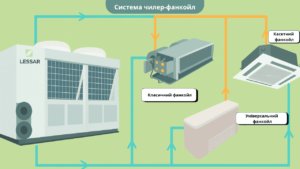
When choosing equipment, you should pay attention to the following parameters:
- Installation type (wall-mounted, floor-mounted, cassette, etc.);
- Availability of automation and control systems;
- Number of pipes (2 or 4);
- Cooling and heating capacity;
- Noise level and dimensions.
If you plan to use a fan coil for cooling, be sure to clarify the temperature parameters of the inlet water and the requirements for the drainage system.
Room area-based selection is carried out according to the following values:
- Up to 25 m² — output 2–2.5 kW;
- 25–40 m² — 3–4 kW;
- 40–60 m² — 5–6 kW.
However, for accurate selection, it is necessary to consider ceiling height, insulation level, number of windows, and orientation by cardinal directions.
There are dozens of fan coil manufacturers on the market, including:
- Daikin
- Gree
- Carrier
- Toshiba
- Midea
Most models are compatible with heat pumps and chillers and are suitable for apartments, offices, and commercial premises.
Is a Heat Exchanger Required for a Fan Coil?
Sometimes in non-standard projects or during renovations, there is a need to replace the heat exchanger. Teplo-Polis offers the manufacturing of individual heat exchangers fully compatible with your fan coil model.
We take into account:
- Installation type;
- Power capacity;
- Heat carrier characteristics;
- Dimensions and installation sizes.
Contact us to get accurate consultation, cost estimation, and production timelines. We operate throughout Ukraine and cooperate with installation organizations.
Fan coil units are convenient, universal, and energy-efficient climate solutions for any type of space. Thanks to a wide range of models, flexible installation, and individual control, fan coils are becoming increasingly popular in both private construction and the commercial sector.
FAQ
Can a fan coil be connected to a heating system?
Yes, a fan coil can be connected to a heating system, especially if it is based on a low-temperature heat carrier (up to 60 °C).
This allows you to use one device for both heating and cooling.
Does the fan coil work in winter?
Yes. With a heat source available (boiler, heat pump), the fan coil effectively heats the room in winter.
It is important to properly select the water supply temperature and avoid freezing of the heat carrier.
How noisy are fan coil units?
Modern models operate quietly — from 25 to 45 dB depending on the mode and fan speed.
Fan coils with inverter control and night mode have especially low noise levels for cooling.
What should I do if the fan coil does not heat?
Check the temperature of the heat carrier, the presence of air in the system (air bleeding may be required),
the operation of the valve and thermostat. If the issue persists — consult specialists for diagnostics.
What documents are required for installing a fan coil in an office?
To install a fan coil in office premises, a project is usually required (if the system is centralized),
coordination with the building’s technical service, commissioning report, and equipment passport.
Last Updated on by Микола Фролкин