
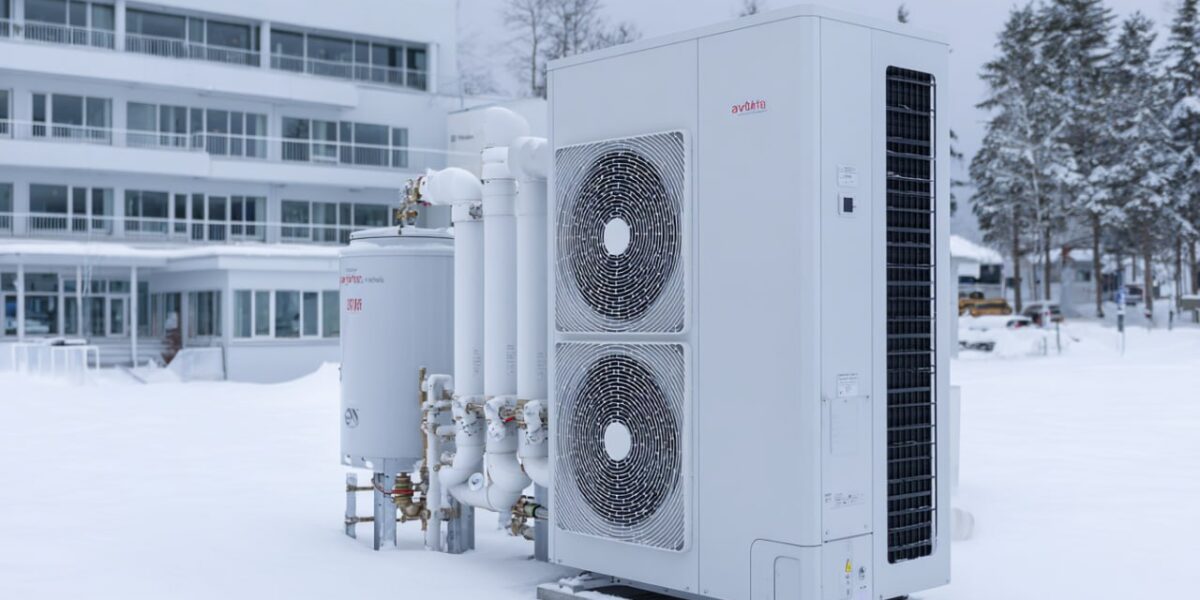
A heat pump is a device that can “transfer” heat from one environment to another. It sounds like magic, but it works according to the very real laws of physics. Imagine an air conditioner, only the other way around: it doesn’t cool, it heats. And sometimes it does both. That’s why a heat pump for home heating is becoming an increasingly popular choice among private homeowners, especially those looking for energy-efficient and environmentally friendly solutions.
A heat pump for home heating is a system that takes heat from the environment (ground, air or water) and transfers it to the house. It runs on electricity, but it spends it not on generating heat, but on “pumping” it – so the costs are significantly lower compared to traditional heaters.
History of heat pump
To understand what a heat pump is, it is useful to look into history. This idea is actually older than it seems. The basics of the device were described back in the 19th century – in 1852, Lord Kelvin (a famous Scottish physicist) formulated the principle of heat transfer from a cold body to a warm one with the expenditure of energy. Sounds complicated? In practice, this is the same thing that a modern pump does: it takes heat from the street and gives it inside the house.
The first heat pumps appeared in the 20s of the 20th century in Europe. In 1928, one of the first systems began to operate in Zurich, heating the city hall. But in mass construction, the technology began to be used only in the 50s – first in Switzerland and Germany, then in the USA and Canada.
Real interest in heat pumps for home heating flared up in the 1970s, when oil prices rose sharply. People began to look for ways to save on heating, and pumps came in handy. Since then, technology has made great strides: inverter compressors, more reliable refrigerants, and the ability to operate in temperatures as low as -25°C have appeared.
Today, a heat pump is no longer an experiment, but one of the key elements of a modern energy-efficient home. Especially in countries with expensive energy resources, such as Germany, Sweden, and Norway. And with the development of solar panels and smart home systems, pumps are becoming part of a broader ecosystem of autonomous and environmentally friendly housing.
How a Heat Pump Works
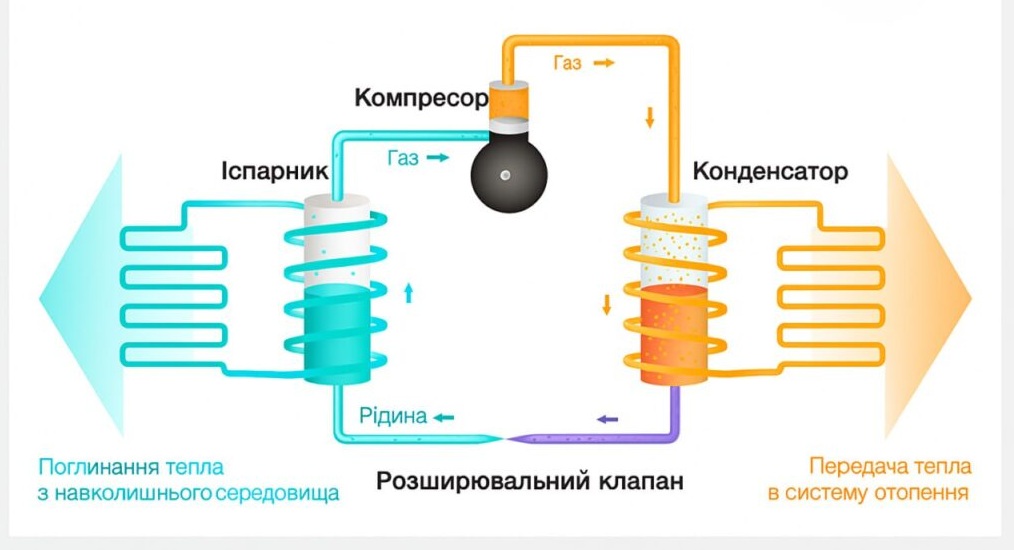
To understand how a heat pump works, you don’t have to be an engineer. Just imagine that it’s like a refrigerator or an air conditioner — only its job is not to cool, but to heat. Although, in fact, heat pumps can do both, depending on the mode.
The essence of the work is in heat transfer. A heat pump for heating a house does not generate heat “from scratch”, like an electric boiler. It moves existing heat from one environment to another. Even if it’s cold outside, there is still energy in the air, ground or water — and the pump carefully collects it.
The usual logic of operation looks like this:
- The pump takes heat from the external environment (soil, air or water).
- The compressor compresses the refrigerant, increasing its temperature.
- The hot refrigerant transfers heat through the heat exchanger to the home’s heating system.
- Then the refrigerant cools down again and returns to “search” for heat – the cycle repeats.
That is, the principle of operation of a heat pump is in the endless “pumping” of heat back and forth, with minimal electricity costs. In fact, from 1 kW of electricity it can “extract” up to 3-5 kW of heat.
The role of the heat exchanger in the system
The heat exchanger is one of the key elements. It is the one that transfers heat from the coolant to the water that goes into the radiators, underfloor heating or boiler. A good heat exchanger ensures efficient heat transfer without losses, and the better the quality, the higher the efficiency of the entire system.
If you are thinking about upgrading your existing heating or want to make the system more efficient, choosing the right heat exchanger can play a decisive role. Even if you are not using a heat pump, but, say, a solid fuel boiler, a heat exchanger can improve heat distribution and reduce losses.
Construction and main components of a heat pump
Although from the outside, a heat pump for heating looks like a regular outdoor air conditioner unit, inside it has a whole engineering “kitchen”. Especially if we are talking about a geothermal heat pump, where everything is tied to the exchange of heat with the earth. But regardless of the type, the main elements of all pumps are approximately the same:
Evaporator
This is where it all begins. In the evaporator, the refrigerant (a special liquid with a low boiling point) takes heat from the environment – air, water or soil. Even at sub-zero temperatures – there is still heat.
Compressor
The heart of the system. It compresses the refrigerant, causing it to heat up rapidly. The compressor is powered by electricity and determines how efficient the heat pump is for heating – the more powerful and modern it is, the higher the performance.
Capacitor
Here, the heated coolant gives off heat to the heating system – water for radiators, underfloor heating or a boiler. This happens through the heat exchanger, which we already mentioned above.
Throttle (expansion valve)
The final chord of the cycle. After the heat is transferred, the refrigerant releases pressure through the throttle, cools down and goes back to the evaporator – for a new cycle.
What heat sources does a heat pump use?
The main “feature” of a heat pump is that it does not produce heat itself, but takes it from nature. And from different natures: from air, from water, from the earth. Hence the different types of systems. Let’s figure out what the difference is between them – in simple terms.
Air-to-water heat pump
This is the most popular option in private homes. The pump takes heat from the outside air and transfers it to the heating system through water. The advantages are ease of installation, low price, no need to drill wells. But there is a nuance: efficiency depends on the outside temperature. In severe frosts, productivity decreases. Despite this, the air-to-water heat pump copes well with the task in most regions of Ukraine and Europe.
Water-to-water heat pump
It works due to the heat contained in groundwater. Two wells need to be drilled: one for water intake, the second for discharge.
A water-to-water heat pump is very efficient and stable in performance, because the temperature of the groundwater is approximately the same all year round – usually from +7 to +12°C.
The downside is the higher cost of installation and the need for drilling permits.
Ground-to-water heat pump
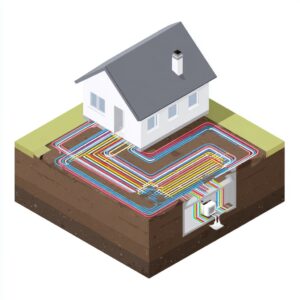 Also called geothermal. This pump takes heat from the soil. It’s even more interesting there: you can bury a horizontal circuit (if there’s a lot of space) or drill vertical wells (if there’s little space but there’s depth).
The ground-to-water heat pump is one of the most stable and efficient, because the soil at depth remains warm even in winter. But the price of the system and the complexity of installation are appropriate.
The choice of the type of heat pump depends on the site conditions, budget, and climate zone. But whichever option you choose, the basis is heat exchange. And the better the quality of the system components (especially the heat exchanger), the higher the return.
Main types of heat pumps
From a technical point of view, a heat pump for a home can look different – both in terms of the heat source, and in terms of the design, and in terms of the circulation principle. To avoid confusion, let’s figure out what the main types are and how they differ. This will help you understand which pump is right for your site, climate, and budget.
The division can be conditionally divided into several categories:
- by heat source (air, water, earth);
- by installation method (monoblock or split system);
- by operating mode (heating / cooling / DHW);
- by design (with or without inverter).
Let’s take a closer look below.
Air-to-air and air-to-water
An air-to-air heat pump is a system that works almost like an air conditioner. It takes heat from the outside air and directly delivers it to the room using an indoor unit. There is no water involved in the system. These pumps most often look like split systems and are used to heat and cool individual rooms.
Advantages:
- easy installation (like an air conditioner),
- fast response to temperature changes,
- suitable for apartments and small houses.
Flaws:
- does not heat water for heating or showering,
works only in those rooms where the indoor unit is installed.
An air-to-water heat pump for home heating is already a full-fledged heating system. It transfers heat from the air to water, which circulates through radiators, underfloor heating or a boiler. This option is well suited for a private home and can completely replace a boiler.
Pros:
- easy installation (no wells needed),
- compatible with conventional heating system,
- can operate in cooling mode in summer.
Water-water and soil-water
Water-to-water heat pumps use heat from ground or surface water. They are very efficient, especially in areas where wells are easily accessible. However, installation requires geological surveys and approvals.
Pros:
- stable water temperature all year round,
- high efficiency even in frost.
Cons:
- drilling and pumping equipment are required,
- higher maintenance costs.
A ground-to-water heat pump (or earth-to-water heat pump) takes heat from the soil. The pipes are laid in the ground, horizontally or vertically, depending on the site. This is one of the most stable and durable types of systems.
Advantages:
- independent of air temperature,
- high seasonal efficiency,
- ideal for autonomous houses.
Cons:
- expensive and complicated installation,
- needs space on the site or drilling.
Features of geothermal models
Geothermal heat pumps are those that operate on the principle of “ground-water” or “water-water”. Their main difference is that the heat source is stable all year round. Even at -20°C in the ground or water at depth, the temperature does not fall below +5…+10°C.
Features of such models:
- ideal for continuous heating without power “drops”;
- more expensive to install, but cheaper to operate over a period of 5-10 years;
- require thoughtful design (heat load, site geology, type of heat exchanger).
If you are building an energy efficient home with the goal of autonomy, geothermal heat pumps (ground or water) may be the best long-term solution.
Advantages and disadvantages of heat pumps
Heat pumps are increasingly becoming a reasonable alternative to gas and electric heating systems. Especially in combination with a high-quality heat exchanger, which directly affects the efficiency of heat transfer to the house. But like any technology, they have their advantages and nuances.
Advantages:
- Economy. The heat pump does not “heat”, but “transfers” heat — and does so 3-5 times more economically than conventional electric heaters. At the same time, it is the heat exchanger that plays a key role in how much heat actually reaches the batteries or underfloor heating. A good heat exchanger means fewer losses and higher output.
- Multifunctionality. Heating, cooling, hot water — all in one device. This is a full-fledged air conditioner and heat pump that operates all year round. It is especially convenient when the system is integrated with an indirect heating boiler through a plate heat exchanger — quickly, stably, without unnecessary energy consumption.
- Environmental friendliness. No fuel combustion, minimum emissions, silence and safety. This approach is especially relevant for energy-efficient homes, where it is important to preserve the heat transferred through high-quality heat exchange units.
- Service life and reliability. Modern heat pumps for the home operate for 15-20 years. And if the system has reliable components inside – especially heat exchangers made of copper or stainless steel – it will reliably withstand both winter and summer without frequent repairs.
- Variety of applications. Today, you can choose not only a heat pump for apartments, but also compact models for a swimming pool – they quickly heat the water, especially if you use an external heat exchanger specially adapted to an aggressive environment.
Flaws:
- Cost at the start. Yes, a high-quality pump with an efficient heat exchanger is not cheap. Especially if you need to heat water or install it in an old house. But this investment pays off in 5-7 years thanks to reduced bills.
- Dependence on the outside temperature. Especially for air-to-water models. In severe frosts, productivity drops. However, using a buffer tank with a heat exchanger can compensate for drops and stabilize the supply temperature.
- Installation and design. Everything must be calculated: from the heat source to the diameter of the pipes and the characteristics of the heat exchanger. Without this, the system will either not heat up enough or will overuse electricity.
- Thermal insulation requirements. If the house “breathes” from all the cracks, even the most efficient pump with an excellent heat exchanger will not save – the heat will escape. Therefore, the pump works in tandem with insulation and balancing of the system.
A heat pump for your home is profitable and convenient. The entire system works as a single unit, and the heat exchanger plays a special role in this bundle. It is responsible for how quickly and efficiently the heat gets to your batteries or pool. Therefore, even if you are not yet ready to buy a heat pump, thinking about a high-quality heat exchanger is already a reasonable step.
Heat pump and heat exchanger – what is the connection?
When it comes to a heat pump, most people think of an outdoor unit and a couple of pipes. But the real work starts inside — and one of the key elements of this system is the heat exchanger.
To understand its importance, let’s look at how it works.
For example, let’s say you have an air-to-water heat pump. It takes heat from the outside air (even at sub-zero temperatures) and needs to transfer that heat into the house. And it does this through the heat exchanger.
Operating principle: air-water
Inside the heat pump, the refrigerant is heated by compression in the compressor. Then it enters the heat exchanger, where the heat is transferred to the water, which then circulates through the heating system – in radiators, underfloor heating or a boiler. In fact, an air-to-water heat pump, no matter how modern it is, loses efficiency without a high-quality heat exchanger. There is enough power, but only part of the heat gets into the house – the rest is lost in the transfer process.
Why is a heat exchanger important during installation?
When installing heat pumps, the choice of heat exchange equipment is often underestimated. A heat exchanger that is too weak may not cope with the load, overheat, or operate with losses. And one that is too simple or cheap may begin to leak or become clogged with deposits over time.
The correct heat exchanger:
- Transfers heat quickly and efficiently;
- Resistant to corrosion, scale and pressure drops;
- Operates stably at low temperatures;
- Increases the overall efficiency of the system.
Installing an air source heat pump is not just about attaching the equipment. It is about setting up the entire chain: compressor, circulation, heat exchanger and automation. If even one element is selected incorrectly, the system will not reach the stated efficiency.
Therefore, even if you do not plan to replace the entire system, but only want to improve its operation, it makes sense to start with the brazed plate heat exchanger. Replacing or upgrading it can increase heating efficiency by 10–20%.
The heat pump is the heart of the system, but the heat exchanger is its arteries. Without it, the heat simply will not reach the house. Therefore, when choosing a pump, do not forget: how efficient it will be depends not only on the brand and power, but also on how and through what it transfers heat.
A heat pump is a modern, economical and environmentally friendly solution for heating, cooling and supplying hot water in the house. It works on the principle of transferring heat from the external environment – be it air, water or earth – and does this much more efficiently than traditional heat sources.
However, it is important to remember: the efficiency of the entire system directly depends on the quality of the components. And first of all — from the heat exchanger. It is responsible for how quickly and stably the heat gets into your home.
If you are considering installing a heat pump or want to increase the efficiency of an existing system — start with selecting reliable heat exchange equipment.
At Teplo-Polis, you can order heat exchangers that are selected for specific tasks: whether it is connecting a heat pump, boiler, boiler or pool. Specialists will suggest the best solution for your type of system and operating conditions.
Energy efficiency begins with competent assembly — and Teplo-Polis knows how to do it right.
Can you use a heat pump in winter?
Yes, modern models work even at -20°C, especially geothermal and air inverter ones. However, in severe frosts, a backup heat source may be required.
What is the difference between an air conditioner and a heat pump?
An air conditioner mainly cools, but a heat pump can heat, cool, and heat water. It is more versatile and efficient in the cold season.
What temperature does a heat pump give?
Typically, the supply temperature to the heating system is 35–55°C — ideal for underfloor heating and low-temperature radiators. For hot water supply — up to 60°C.
Is a separate heat exchanger needed?
Yes, especially if you connect the pump to a boiler, pool or multi-circuit system. It improves heat transfer and protects the equipment from overload and contamination.
Last Updated on by Микола Фролкин