
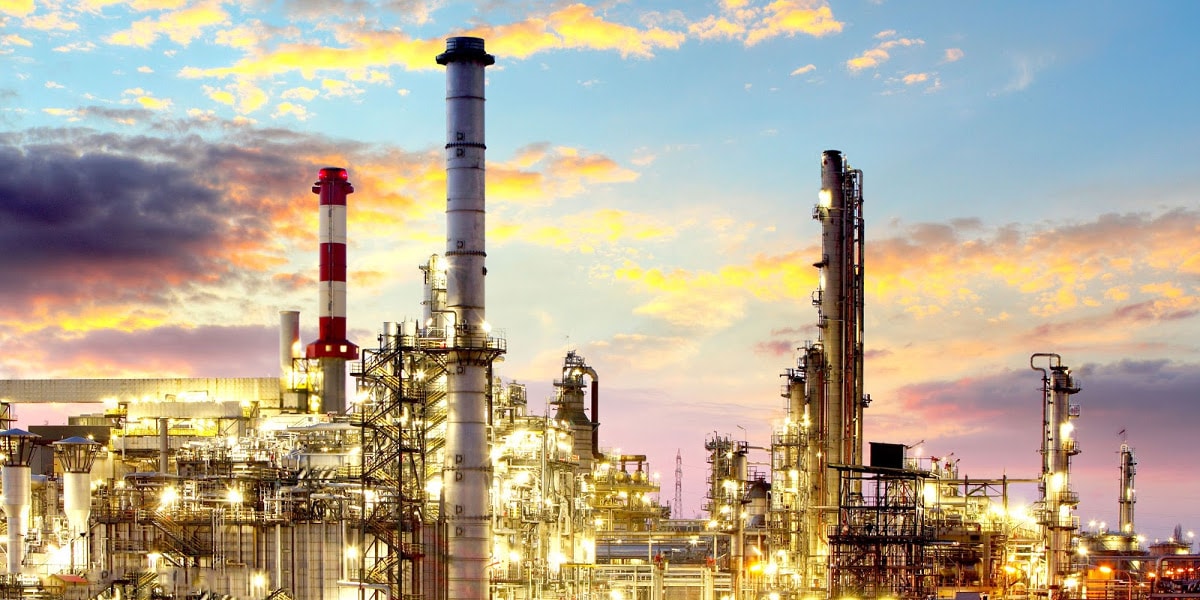
Heat exchange equipment for the petroleum refining industry ensures effective heat exchange between media during heating, cooling, evaporation and condensation. Without this, the processes of rectification, cracking, polylysis and polymerization are impossible. Heat exchange systems in naphtha refining plants allow a reduction in energy consumption by 30–40% for heat recovery and improvement of the heat recovery factor of process units.
Main tasks of heat exchangers in petrochemicals
Heat exchangers in the oil refining industry solve the following:
- Preparation of raw materials for processing – heating oil and gas to 300–400 °C before rectification.
- Efficient condensation of products – conversion of gases into liquids at temperatures down to -40 °C in refrigeration units.
- Heat recovery – recovery of up to 60% of energy from waste process streams.
- Maintaining temperature regimes in reactors – ensuring stable conditions for polymerization and pyrolysis.
There are the following types of heat exchangers in oil refining according to their purpose:
- Raw material heaters are used in atmospheric and vacuum oil distillation plants. Operating temperatures are 250–400 °C. It is important to consider the resistance of materials to thermal expansion and high-temperature coking.
- Heat exchangers for oil desalting, dehydration and separation. The temperature of oil preparation before electrical desalting is 110–140 °C. Shell-and-tube heat exchangers with high corrosion resistance are used.
- Recuperators of technological processes allow saving up to 60% of thermal energy. For example, in cracking plants, heated hydrocarbons transfer heat to the raw material, reducing fuel consumption in furnaces.
- Condensers of the upper products of rectification columns. Operating temperatures are 50–150 °C.
- Used for condensation of gasoline fractions, stabilization of kerosene and diesel fuel.
- Heat exchangers in pyrolysis, polymerization and resin boiling plants. In pyrolysis plants, heat exchangers operate at 500–850 °C. For polymerization, jacketed cooling devices are used that maintain a temperature of 120–250 °C.
- Circulating irrigation heat exchangers maintain the temperature of circulating flows in atmospheric and vacuum distillation columns at 180–300 °C.
- Final coolers of finished products cool petroleum products before storage and transportation. It is important to take into account the viscosity of the product and the ambient temperature, especially for bitumen and fuel oil.
- Heat exchangers of auxiliary technological processes are used in systems for heating factory premises, heating water for technical needs and regenerating solvents.
- Heaters in raw material heating units of petroleum product discharge systems maintain the fluidity of fuel oil, oils, and bitumen at a temperature of 100–200 °C, reducing losses during transportation.
How do Teplo-Polis heat exchangers increase process efficiency?
The heat exchanger for oil of the Teplo-Polis company was designed taking into account the specifics of petrochemical production.
The equipment is made of corrosion-resistant alloys:
- Stainless steel AISI 316L – withstands temperatures up to 600 ° C, resistant to acids.
- Titanium alloys – ideal for contact with sulfurous oil and sea water.
- Special coatings (hard alloy, polymer) protect against aggressive reagents.
Such solutions increase the service life of heat exchangers by 30-50%, compared to standard models.
Teplo-Polis oil heat exchangers use corrugated and finned plates that:
- Increase the heat exchange area by 20–30%.
- Ensure uniform heating and cooling of flows.
- Reduce costs for additional heating of raw materials.
Shell-and-tube models are equipped with an innovative tube bundle design that minimizes deposits on the walls and improves coolant circulation.
Modern technologies of “Teplo-Polis” allow:
- Reduce fuel and electricity consumption by 15–25%.
- Reduce the load on pumping equipment due to low hydraulic resistance.
- Reduce the risk of overheating and accidents due to the built-in temperature and pressure monitoring system.
How to choose a heat exchanger for petrochemical production?
Proper selection of a heat exchanger affects the efficiency of oil and gas processing.
Before choosing a heat exchanger, you must:
- Determine the type of technological process (rectification, condensation, heating of petroleum products).
- Calculate the need for thermal power.
- Take into account operating conditions (corrosive environment, high temperatures, presence of solid impurities).
The operating temperature of the heat exchanger must meet production requirements:
- For oil distillation – 250–400 °C.
For pyrolysis processes – 500–850 °C.
For cooling petroleum products – from -40 °C (deep cooling) to +150 °C (condensation).
Working pressure from 0.6 to 10 MPa, depending on the process line.
It is also important to consider:
- Aggressiveness of the environment (hydrogen sulfide, acids, seawater).
- Viscosity and thermal conductivity of the coolant.
- Possibility of formation of deposits and contaminants (tars, oil fractions).
The performance of a heat exchanger is determined by the volume of raw material being processed and the rate of heat exchange. For example:
- For atmospheric distillation – 200–500 m³/h.
- For catalytic cracking units – 100–300 m³/h.
- For condensate coolers – 50–200 m³/h.
Why choose “Teplo-polis”?
Teplo-Polis is one of the leaders in the production of heat exchangers for oil refineries. Over the past 20 years, the company has implemented hundreds of projects, ensuring reliable and energy-efficient operation of technological processes.
Each technological process is unique, therefore “Teplo-Polis” develops heat exchangers that fully meet the client’s requirements. The following are taken into account:
- Temperature and pressure parameters of the system.
- Aggressiveness of the working environment (acids, alkalis, petroleum products with a high sulfur content).
- Features of the location of equipment at the facility.
Guaranteed quality and compliance with industry standards
Teplo-Polis heat exchangers undergo multi-stage quality control and comply with standards.
Teplo-Polis offers comprehensive project support:
- Development of a technical solution.
- Production of a heat exchanger taking into account all requirements.
- Delivery of equipment to the facility.
- Installation and commissioning.
- Technical maintenance and consulting support.
How to order a heat exchanger for the oil refining industry?
To place an order, all you need to do is:
- Fill out the form on the official website of “Teplo-polis”.
- Call and get a consultation from a specialist.
- Leave a request for the development of an individual project.
The company’s managers will help you choose the optimal solution designed for specific operating conditions and ensure timely delivery of equipment.
Last Updated on by Микола Фролкин