
Plate Heat Exchangers for Milk Production
In modern dairy industry, attention to details and technological solutions has become a key aspect in ensuring high productivity and product quality. One significant component of this process is heat exchangers, particularly plate heat exchangers. Here, they are used as heaters, coolers, recuperators.
A plate heat exchanger for milk is a device that operates based on heat exchange between two mediums through contact plates without mixing.
The use of heat exchangers in dairy industry processes
It is an integral part of the technological process – effectively performs operations such as:
1.Pasteurization. It is one of the most common methods of milk treatment to destroy harmful microorganisms. A plate pasteurizer for milk plays an important role in this process by providing uniform and precise heating of milk streams. Pasteurizers used in the dairy industry come in various types: 3-section heat exchanger, 4-section (with an outlet for homogenization), 5-section (with an outlet for homogenization and two-stage cooler).
Milk pasteurizer
Pasteurizers used in the dairy industry come in three-, four-, and five-section configurations.
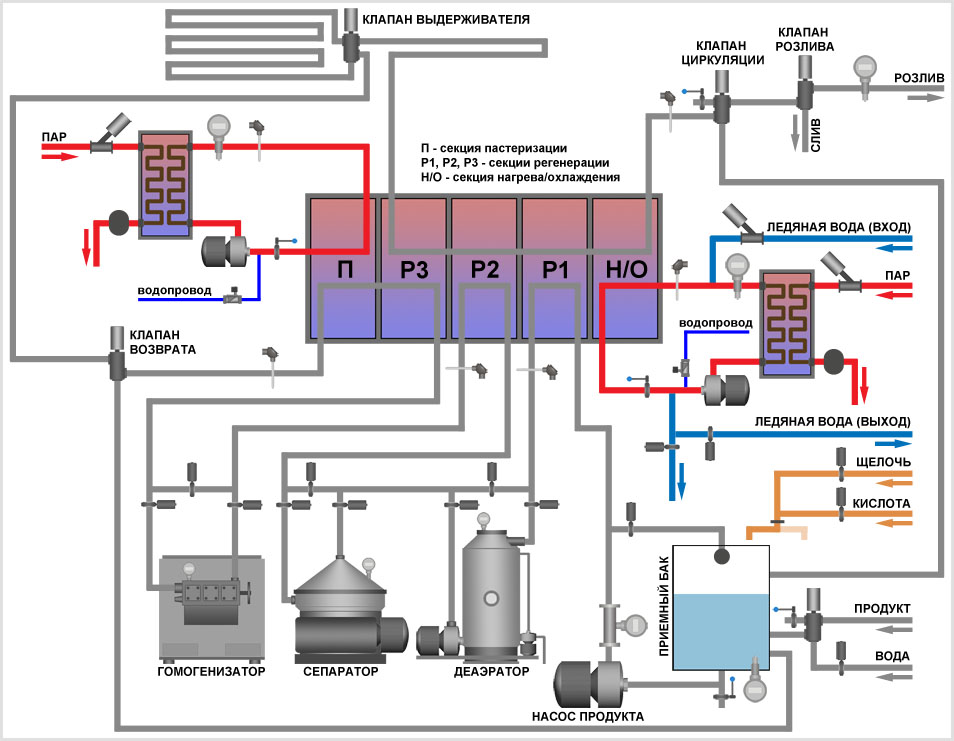
When calculating pasteurization units (Figure 1), the following parameters should be considered:
- The specified temperature regime for pasteurization and milk cooling;
- The temperature of raw milk at the inlet to the regeneration (recuperation) section of the 1st stage can range from 10 to 35°C;
- The milk separator of the unit provides a high level of milk purification exiting the regeneration (recuperation) section of the 1st stage at 37…45°C;
- The temperature of the hot water at the inlet to the pasteurization section is set 2…18°C higher than the milk pasteurization temperature, taking into account the boiling point;
- The milk is cooled to 4…10°C considering the season and local conditions;
- When calculating the unit, depending on the pasteurization, milk cooling regime, and climatic conditions, the temperature of the cooling fluids can be: artesian water — 4…10°C; tap water — 5…16°C; ice water — 1…4°C; brine — 0…-5°C.”
2.Ultra-pasteurization of milk. It significantly extends the shelf life of milk without adding preservatives, while preserving their taste and nutritional qualities.
The advantages of using heat exchangers in ultra-pasteurization
Efficiency: Enables fast and uniform heating of milk, allowing the desired temperature to be reached in minimal time. Energy savings: Optimizes heating and reduces energy consumption, eliminating the need for energy-intensive and bulky equipment for ultra-pasteurization of milk. Process control: Allows precise control of the product heating temperature, eliminating overheating or underheating. During milk sterilization, the milk is typically heated above 100°C and held for 20–30 minutes. Sterilizing milk at 100°C destroys pathogenic microflora, but prolonged temperature exposure negatively affects milk’s taste qualities. During pasteurization, milk is heated from 72 to 120°C and held for a short time. The choice of processing temperature depends on the microbiological quality of the raw material and the desired shelf life. Currently, low-temperature (not exceeding 76°C) and high-temperature (from 77 to 120°C) pasteurization are used in milk production. According to the WHO and IDF (International Dairy Federation) definition, pasteurization ensures the absence of pathogenic microflora throughout the entire shelf life. Preservation of properties: Rapid temperature reduction after ultra-pasteurization helps preserve all taste and nutritional characteristics.
3.Cooling plays a crucial role in maintaining the quality of products and ensuring their long shelf life, specifically the cooling of milk after pasteurization or ultra-pasteurization. Dairy products are rapidly cooled to low temperatures, which reduces microbial growth and preserves organoleptic properties. The milk cooler efficiently removes heat from the product, uniformly reducing the temperature and preventing the formation of ice crystals, which could otherwise damage the structure and texture.
The purpose of heat exchangers in cooling for the dairy industry.
In the modern world, where efficiency and optimization play a significant role in industrial production, choosing the right heat exchange methods becomes an integral part of successful milk production. Plate coolers for milk offer a range of economic and environmental benefits, making them an indispensable component in milk manufacturing.
- Milk cooler;
- Two-stage milk cooler (water, propylene glycol);
- Cream cooler;
- Cream pasteurizer;
- Yogurt cooler;
- Yogurt pasteurizer;
- Curd cooler;
- Ice cream cooler;
- Ice cream cooler;
- Whey cooler;
- Kefir cooler;
- Sour cream cooler;
- Dessert cooler;
- Whey cooler;
- Ayran cooler.
Models of heat exchangers manufactured by “Teplo-Polis”
| ТП | Throughput capacity |
| ТП 1А | до 8 т/ч |
| ТП 2В | до 40 т/ч |
| ТП 1Н | до 140 т/ч |
| ТП 1 Е | до 280 т/ч |
Economic and environmental benefits
Economic advantages
- Efficient heat transfer and product integrity
They ensure efficient heat transfer between different mediums, which is particularly significant in milk processing. They have a compact design where milk and the heat transfer medium (coolant) exchange heat through thin plates. This allows achieving high-speed heating or cooling of milk while preserving its properties and nutritional value. - Energy savings and cost reduction
It contributes to reducing energy consumption during milk heating and cooling. Due to its efficiency and ability to rapidly transfer heat, as well as the careful selection of the recuperation section where the product maximally gives/takes heat from the product moving in the opposite direction. - Reduction of manufacturing time and increase in productivity
It leads to increased equipment productivity and, consequently, to a higher volume of dairy product production within the same period of time. - Minimization of losses and improvement of quality
Thanks to precise temperature control and uniform heat distribution. This is especially important for dairy products, as even minor changes in the processing can affect taste, texture, and nutritional value. - Reduction of maintenance and repair costs
They have a strong and durable construction, minimizing the need for frequent maintenance and repair.
Environmental benefits
- Energy efficiency.It contributes to a more efficient use of energy resources, which reduces the negative impact on the environment. Reduction in energy consumption also helps to lower greenhouse gas emissions.
- Reduction in water consumption. They reduce water usage when lowering the temperature of milk. This is particularly relevant in regions facing water scarcity.
- Minimization of waste. Thanks to precise temperature control and lower product losses, milk production using heat exchange equipment allows minimizing waste and improving overall efficiency.
- Durability and recyclability. Plate heat exchangers are typically made from materials that have a long service life and can be recycled.
- Advanced cleaning technologies. Equipped with automated cleaning systems, which reduce the need for chemical cleaning agents and water. This also contributes to resource conservation and reduces the negative impact on the environment.
Requirements for heat exchangers in the dairy industry
- Plate material: food-grade stainless steel or titanium;
- Gasket material: food-grade rubber;
- Clamping plate material: stainless steel or carbon steel plated with stainless steel;
- Pipe material: stainless steel.
Collaboration scheme with Teplo-Polis
Step 1: Understanding Your Needs
The main value of the company is our customers. We are ready to carefully listen to your requirements and discuss details to ensure the successful implementation of the project. Through thorough analysis, we develop the best and most suitable solution, considering all your needs.
Step 2: Professional Installation Design
Taking into account all the details and technical parameters, we calculate the heat exchanger for the dairy industry and develop an individual scheme for your system. Using advanced technologies and innovative approaches, we create reliable and efficient equipment that guarantees maximum comfort and cost-effectiveness.
Step 3: Quality Equipment and Materials
Plays a key role in the reliable and efficient operation of the system, as well as in building long-term relationships with customers. Using trusted and reliable suppliers, as well as our own manufacturing, ensures that our services meet high standards and customer expectations.
Step 4: Prompt Servicing and Support
We are always ready to provide prompt support and answer your questions. Regular maintenance and professional care of the system help maintain its efficiency for a long time.
Why Choose Teplo-Polis
We are a team with over 20 years of experience in the market. Our success is based on an individual approach and professionalism. We value your time and comfort, so all our actions are aimed at minimizing your hassle.
We work transparently and honestly, providing detailed information about the cost and progress of work. With us, you will get a reliable partner and a high level of service.
Last Updated on by Микола Фролкин