

The oil and fat industry is a complex technological process where product quality is directly dependent on compliance with temperature regimes. Heat exchangers play a key role in ensuring the stability and efficiency of production stages such as extraction, refining, deodorization.
The main stages of production where heat exchangers are used:
- Oil extraction – heating the raw material before extraction improves oil yield and quality.
- Refining – heating and cooling the oil during the hydrotation, neutralization and bleaching stages helps remove impurities and improve product purity.
- Deodorization – heating the oil to high temperatures helps to remove unwanted odors and improve the taste of the final product.
Heat exchangers reduce energy costs through efficient heat recovery and minimize waste, making production more environmentally friendly.
I am a text block. Click the edit button to change this text. Diverse and rich experience constant quantitative growth and the scope of our activities require us to analyze positions.
How to select and use a heat exchanger?
The choice of heat exchanger depends on the process requirements. Depending on the production requirements, a particular heat exchanger can be selected.
The main types of equipment:
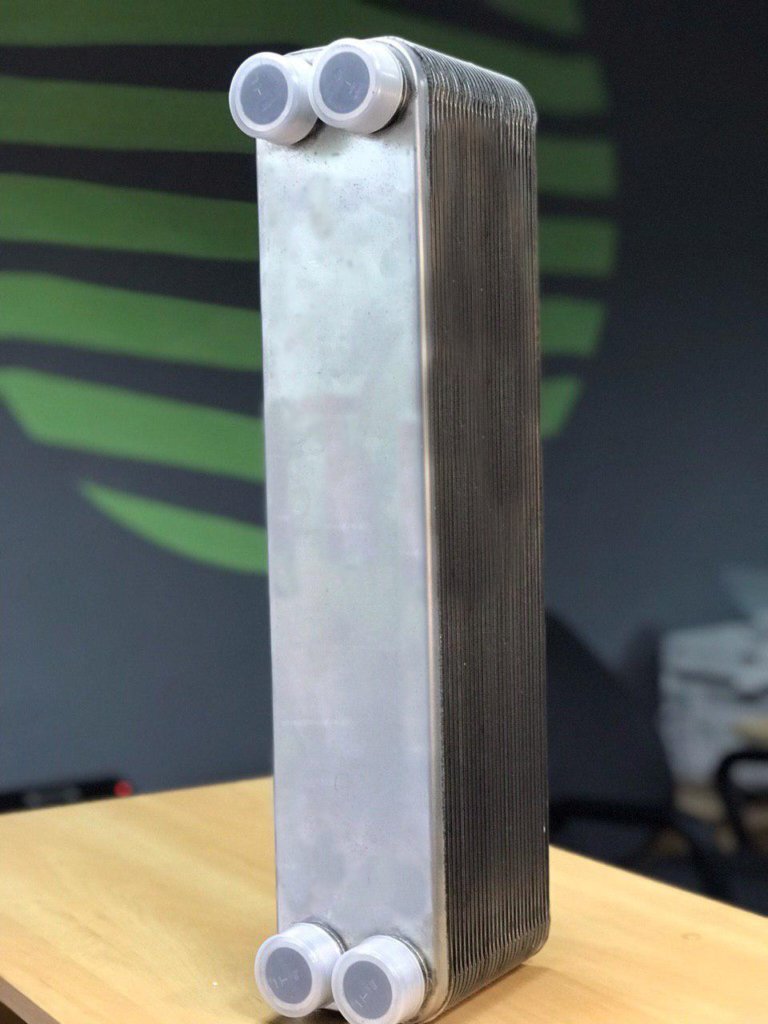
- Plate heat exchangers – ideal for handling liquid media such as vegetable oils due to their high heat transfer and compactness. Their ease of maintenance makes them the most popular.
- Tubular heat exchangers – used for high temperatures (over 195 degrees Celsius) and pressures, as well as for highly viscous and contaminated media. Their design provides durability and resistance to corrosive media, but requires more space.
- Spiral heat exchangers are a universal solution for handling a variety of fluids. Their key advantage is their high resistance to clogging, which is important when processing raw materials with impurities.
Plate heat exchangers are particularly relevant for the oil and fat industry due to their compactness, efficiency and ease of operation.
Designation of heat exchangers in the oil and fat industry
Teplo-Polis offers a wide range of heat exchange equipment designed to fulfill specific tasks:
- Hydrotation oil heater – provides uniform heating of oil at the stage of hydrotation, which helps to improve its consistency.
- Steam pre-neutralization heater – heats the feedstock by means of steam. It is used to prepare oil for chemical treatment, increasing the efficiency of the process.
- Water heater before neutralization – used to heat feedstock with water, minimizing energy consumption.
- Oil heater before bleaching – heats the oil evenly, improving conditions for removing unwanted pigments.
- Vegetable oil cooler before vintarization (freezing) – reduces the oil temperature to crystallize solid fats and subsequently remove waxes from the oil.
- Oil heater after vintarization (freezing) – heats the oil to operating temperature for further processing.
- Oil heater before deodorization – raises oil temperature to remove volatile compounds and improve flavor characteristics.
- Post deodorization oil cooler – cools the finished product to ensure its stability during storage.
- Deodorization oil recuperator – allows you to use the heat of used oil to heat new oil, reducing energy costs.
When selecting a heat exchanger for the oil and fat industry, it is important to consider the following criteria:
- The chemical composition, viscosity and temperature of the fluid affect the choice of design.
- Consider the required capacity of the heat exchanger, expressed as the amount of heat it can transfer in a given time.
- This depends on processing volumes and equipment speed.
- Space constraints may require compact solutions such as plate heat exchangers, which take up less space than tube heat exchangers.
- Specify heat transfer coefficient and heat recovery capability. Energy efficient heat exchangers reduce energy and steam costs.
- Ensure that the heat exchanger is capable of maintaining a given temperature rating under high or variable flow conditions.
- For the food industry, it is important that the equipment complies with sanitary and hygienic standards (e.g. ISO or HACCP).
- The operating conditions, including pressure, temperature, and connection capabilities, must match the design parameters of the heat exchanger.
- Check whether the cost of the heat exchanger fits within your budgetary constraints and how quickly it will pay for itself through resource savings.
Correct selection of the heat exchanger provides stability of operation, minimizes costs and increases the quality of the final product. For a more accurate selection it is recommended to consult with the engineers of the company “Teplo-Polis”.
Last Updated on by Микола Фролкин