
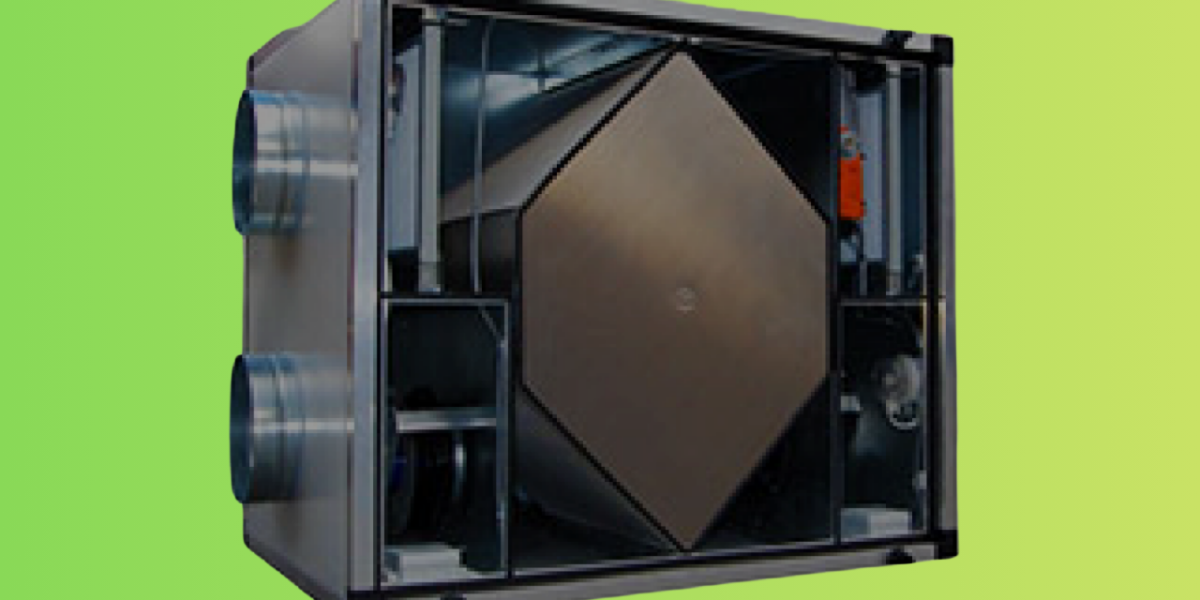
Heat recovery is not magic or a marketing trick, but a quite practical engineering technology that has long been used in the food industry. The idea is simple: in one technological cycle, a liquid needs to be heated (for example, vegetable oil before filtration or milk for pasteurization), and in the next — the same liquid must be cooled to the specified temperature. To avoid wasting extra energy, a heat recovery system is used: the hot product gives part of its energy to the cold one, and both streams exit with the required parameters at minimal cost.
This scheme is used in the fat-and-oil industry, as well as in the production of milk, beer, juices, and other beverages. At the principle level, everything is simple: energy doesn’t disappear — it can be returned and reused where it is needed. That is why heat recovery systems have become a fundamental method of reducing heating and cooling costs for liquids in food processes, maintaining product quality and lowering production costs.
Basic concepts and principles of heat recovery
To avoid confusion in terms, let’s define: heat recovery is the process of direct heat exchange between two flows through a partition or a special heat exchange element. In the food industry, such devices are most often plate and tubular heat exchangers, which provide efficient heat transfer between hot and cold liquids without mixing them.

There are international standards (for example, ISO 11863 for hygienic heat exchangers, EHEDG recommendations for sanitary processing) that help engineers select the right equipment for working with milk, oil, or beverages.
A typical heat recovery system in food production includes:
- A heat exchanger (plate or tubular) — the heart of the system, where heat transfer between the flows takes place.
- Pumps — ensure the circulation of liquid with the required pressure and speed.
- Automation — regulates temperature and flow, maintaining balance and process safety.
- Filtration elements and sanitary units (CIP systems) — maintain hygiene and stable equipment efficiency.
In the correct configuration, such industrial heat recovery allows up to 90% of the energy used for heating liquid products to be returned and reused for their cooling. This reduces steam, water, and electricity consumption, accelerates the technological process, and makes production more environmentally friendly.
Properly selected and commissioned heat recovery systems are a reliable tool for optimizing production in the dairy, fat-and-oil, and brewing and soft drink industries.
How heat recovery works
What is heat recovery in liquid media? Imagine a technological process: vegetable oil needs to be heated to a high temperature before filtration and then cooled before storage. Or milk, which is first pasteurized at 72–75 °C and then quickly cooled to 4–6 °C. If this is done “head-on” using steam boilers and refrigeration units, energy is spent twice. But with a heat recovery system, direct heat exchange between the hot and cold product can be organized, reducing heating and cooling costs.
The system is based on plate and tubular heat exchangers. The hot batch of product transfers energy to the cold one through thin channel walls, maintaining hygienic separation. As a result, the same energy is used twice — for heating and for cooling.
Types of implementation:
- Plate heat exchangers — provide a high heat transfer coefficient and are used in the dairy and brewing industries.
- Tubular heat exchangers — more resistant to contamination, suitable for viscous liquids (oil, syrups).
- Heat recovery from refrigeration equipment — the heat from condensers is used to heat water, washing solutions, or for preliminary product heating.
- Combined heat recovery systems — integrate pasteurization, cooling, and CIP-solution heating processes into a single scheme.
What affects efficiency:
- Flow rate and product velocity — if they deviate from the design parameters, heat recovery efficiency decreases.
- Cleanliness of heat exchange surfaces — fouling or deposits sharply reduce the heat transfer coefficient (therefore, a CIP system is mandatory).
- Temperature profile — the greater the temperature difference between the flows, the higher the efficiency.
- Materials — stainless steel AISI 304/316L or titanium ensure hygiene and durability.
In a properly adjusted system, the efficiency of heat recovery in food production reaches 70–90%, as confirmed by practical experience and standard requirements.
Difference between heat recovery and other types of heat exchange
In the food industry, it is important to distinguish between several approaches:
- Heat recovery — direct heat exchange through the wall of a heat exchanger, where the hot and cold products move toward or parallel to each other without mixing.
- Regeneration — accumulation of energy in an intermediate medium (for example, water or glycol), followed by its transfer to another flow.
- Heat pump — an active system that transfers heat using a compressor, consuming electricity, and capable of increasing the temperature of the heat carrier.
When to apply each:
- Heat recovery (plate and tubular units): the optimal solution for dairy plants and breweries, when heating and cooling of the same batch of product need to be combined.
- Regenerative systems: appropriate when working with intermediate liquids and large volumes.
- Heat pumps: used where the temperature of the heat carrier needs to be additionally increased (for example, heating water above 80 °C).
Heat recovery is “passive saving,” regeneration is an intermediate option, and heat pumps are an active tool. In the food industry, they are often combined.
Why is heat recovery needed?

The main goal is to reduce energy costs without compromising product quality. In the fat-and-oil industry, this means less steam and cold water with the same production volumes. In the dairy sector — reducing the costs of milk pasteurization and cooling. In brewing — saving on wort heating and simultaneously recovering cold for fermentation.
Practical benefits:
- reduction of steam and cooling costs by up to 50%;
- reduction in the size of boilers and refrigeration units due to heat recovery;
- improvement of temperature stability, and therefore — product quality;
- environmental friendliness: less CO₂ emissions and energy waste;
- compliance with international energy management standards ISO 50001 and sanitary standards EHEDG.
Heat recovery is a rare case when economy, comfort, and regulations are “on the same side.” It does not replace competent design, but makes it significantly more efficient and predictable.
Types of heat recovery
There are many classifications, but for practical use in food production, it is convenient to distinguish four main approaches:
- direct-flow recovery (through-wall heat exchange via a heat exchanger);
- regenerative schemes (heat accumulation and release, less common in the food industry);
- plate heat exchangers as the most common type of equipment for liquid media;
- industrial heat recovery — using heat from refrigeration units, compressors, and pasteurization equipment.
Let’s look at each approach in more detail.
Direct-flow recovery
“Direct-flow” means the transfer of heat from the heated product to the cold one through the wall of a heat exchanger without energy accumulation. Most often, these are plate or tubular units where two flows move toward each other and exchange heat.
Advantages:
- high hygiene — products do not mix, flows are separated;
- flexible integration into process lines;
- easy maintenance (CIP cleaning, control according to ISO 11863).
Disadvantages:
- lower efficiency compared to complex regenerative schemes;
- the need for regular sanitary cleaning to maintain heat transfer.
Applications:
- in the fat-and-oil industry for heating and cooling vegetable oil;
- at dairy plants for pasteurization and cooling of milk;
- in brewing for wort heating and subsequent cooling.
Direct-flow heat recovery is a basic solution for liquid products when hygiene, reliability, and simplicity are essential.
Rotary (regenerative) heat recovery
In liquid media, classic rotary wheels are almost never used. However, the principle of regeneration is well known: energy is temporarily stored in an intermediate heat carrier (for example, in a glycol circuit) and then transferred back to the product.
Advantages:
- processes of heating and cooling can be separated in time;
- suitable for complex schemes with parallel lines.
Disadvantages:
- lower efficiency compared to direct plate heat exchangers;
- additional costs for circulating the heat carrier.
Applications:
- on production lines where the hot and cold products are physically separated (different workshops or floors);
- in technological schemes with an intermediate glycol loop for cooling beverages or dairy products.
Regeneration in the food industry is used less frequently but remains an option for complex production systems.
Plate heat exchangers

This is the most common type of heat recovery system in the dairy, fat-and-oil, and brewing and soft drink industries. Two flows pass through alternating channels separated by thin stainless steel plates (AISI 316L), through which heat exchange occurs.
Advantages:
- high efficiency (up to 90% energy recovery);
- compact design and modular expandability;
- easy sanitary cleaning (CIP);
compliance with international ISO and EHEDG standards.
Disadvantages:
- sensitivity to contamination and solid particles;
- the need for regular cleaning and gasket tightness control.
The plate heat exchanger is the “workhorse” of food production, providing the optimal balance between efficiency and hygiene.
Industrial heat recovery
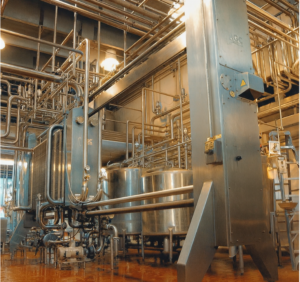
In the food industry, heat recovery from refrigeration units and compressors is actively used. Refrigeration machines release a large amount of heat into condensers, and this heat can be returned to the process.
Examples of application:
- heating water for CIP cleaning at dairy plants;
- heating process solutions in the fat-and-oil industry;
- year-round water heating in breweries and beverage production;
- using compressor heat for space heating or domestic hot water preheating.
In some cases, international energy efficiency standards (for example, ISO 50001, ASHRAE 90.1) directly recommend or even require the recovery of “excess” heat from refrigeration equipment.
Industrial heat recovery is a separate field where energy savings are achieved by utilizing heat that was previously simply released into the atmosphere.
Where heat recovery is used
Heat recovery has long been applied not only in building ventilation. In the food industry, agriculture, and transport, such systems help save energy in processes where products or liquids are sequentially heated and cooled. This is especially relevant for milk, beer, juices, and vegetable oil, where the technological cycle requires both high temperatures and subsequent rapid cooling.
Ventilation systems in residential buildings
In residential construction, heat recovery is most often discussed in the context of ventilation, but similar principles are applied in food technologies for heating and cooling liquid products. Here, the role of a “supply and exhaust ventilation system with heat recovery” is performed by a plate or tubular heat exchanger, where the hot product transfers heat to the cold one.
Example: in the dairy industry, pasteurized milk is cooled by a counterflow of raw milk, recovering up to 90% of the energy. This approach reduces steam and cooling costs while maintaining process hygiene in accordance with ISO and EHEDG standards.
Production and industrial facilities
Industrial heat recovery primarily involves the use of heat exchangers for liquid media. In the fat-and-oil industry, vegetable oil is first heated to the required temperature and then cooled before packaging. Thanks to heat recovery, the same heat is used twice.
In brewing, hot wort is cooled by a counterflow of water or a new batch of wort. At the same time, heat recovery from refrigeration units allows additional recovery of heat from compressor condensers for heating water or CIP solutions.
Such heat recovery systems turn energy losses into a source of savings and reduce the payback period of equipment.
Automotive industry
In the transport sector, heat recovery refers to the use of exhaust or engine coolant heat to power auxiliary systems and reduce fuel consumption. The most well-known approaches include:
– thermoelectric generators on the exhaust system;
– heat exchangers for faster heating of coolant and the cabin;
– turbocompound and small steam cycles for recovering part of the mechanical work.
Research shows that a thermoelectric generator on the exhaust can deliver hundreds of watts and add several percent to fuel efficiency in driving cycles, while exhaust heat recovery systems accelerate engine warm-up and reduce emissions during the cold phase.
The automotive industry views heat recovery as a cumulative reserve of powertrain efficiency: each solution individually contributes a few percent, but it is the integrated management of thermal flows that provides a noticeable result without compromising durability.
Agriculture and greenhouses
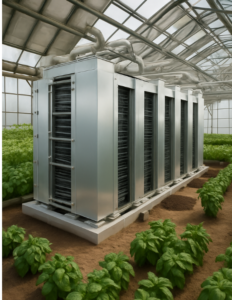
In greenhouse farming, ventilation with heat recovery helps solve the long-standing dilemma: it is necessary to remove moisture and excess heat without losing the accumulated “climate.” Compact air-to-air heat exchangers are useful for this purpose, as they simultaneously provide ventilation and reduce heating costs, especially during the off-season and winter.
In the agricultural sector, not only air-to-air heat recovery is used but also wastewater heat recovery. After washing vegetables or dairy lines, warm water can preheat fresh batches, reducing heating costs.
In greenhouses, similar principles are applied to circulating water: the heat is not wasted but returned to the heating system. This helps reduce heating costs during the cold season and stabilizes the greenhouse climate without loss of yield.
Advantages of heat recovery
A heat recovery system in the food industry allows up to 60–90% of the energy — which would otherwise be lost during the heating and cooling of liquid products — to be recovered. In the dairy industry, this means less steam for pasteurization and less cold water for cooling. In brewing — the reuse of wort heat to preheat a new batch. In the fat-and-oil industry — reduced costs for heating and cooling oil.
Key advantages:
- Resource savings. Reduced consumption of steam, water, and electricity.
- Process stability. Constant heating and cooling temperatures improve product quality.
- Reduced loads. Lower energy consumption for boilers and refrigeration units means lower capital and operating costs.
- Environmental friendliness. Reduced CO₂ emissions and compliance with international energy management standards (ISO 50001).
Heat recovery is a way to simultaneously increase production efficiency and reduce production costs.
Disadvantages and limitations
Like any technology, heat recovery systems have their nuances.
- Initial investment: plate heat exchangers and integration into process lines are more expensive than simple “direct” heating and cooling schemes.
- Maintenance requirements: regular CIP cleaning is necessary to maintain hygiene and heat transfer efficiency.
- Balance of benefits: if the system is designed without considering the operating modes of refrigeration units or compressors, the effect may be lower than expected.
- Operating conditions: depending on the viscosity and contamination level of the product, the type of heat exchanger is selected (plate, tubular, or shell-and-tube).
Without proper design and maintenance, heat recovery systems may operate inefficiently, but with correct implementation, these limitations become manageable.
Design and operating principle of a heat recuperator
To understand how industrial heat recovery works, it is important to look at the structure of a heat exchanger. In food processes, a recuperator is not just a “box with a fan,” but a complex unit where every component is responsible for hygiene, efficiency, and process safety.
Design features
The classic composition of an industrial system includes:
- Plate heat exchanger — optimal for milk, beer, and juices; provides a high heat transfer coefficient.
- Tubular or shell-and-tube heat exchanger — suitable for viscous products (oils, syrups) and less sensitive to contamination.
- CIP system — essential for sanitary cleaning and maintaining efficiency.
- Automation — controls flow rate, pressure, and temperature, preventing overheating or overcooling.
The design depends on the product, but the goal is the same — to return heat to the technological cycle as efficiently as possible.
Materials of construction
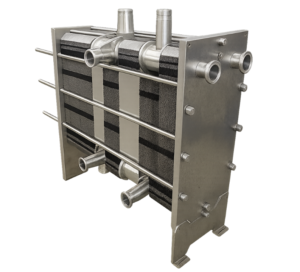
In the food industry, the choice of materials is critical.
- Stainless steel AISI 304/316L — the standard for dairy and beverage production, resistant to corrosion and acids.
- Titanium — used in cases of aggressive environments or saline solutions.
- EPDM or NBR gaskets — resistant to CIP cleaning agents and high temperatures.
- Hygienic designs according to EHEDG — ensure complete tightness and easy sanitary maintenance.
The correct choice of materials is the key to the durability and safety of heat recovery systems.
| Unit | Material | Features | Where used |
|---|---|---|---|
| Heat exchanger plates | Stainless steel AISI 304/316L | Hygiene, resistance to acids and alkalis | Dairy industry, brewing, juices |
| Gaskets | EPDM, NBR | Resistance to CIP cleaning agents and temperatures up to 120 °C | All food industries |
| Tubes of shell-and-tube heat exchanger | Stainless steel or titanium | Operation with viscous and aggressive media | Fat-and-oil industry, chemical processing |
| Housing | Hygienic stainless steel | Tightness, easy cleaning | Dairy plants, pharmaceuticals |
| Automation | Pressure, temperature, and flow sensors | Process control, protection of compressors and pumps | All industrial lines |
The right material is a balance between heat transfer, corrosion resistance, and hygiene.
Installation of a heat recovery system
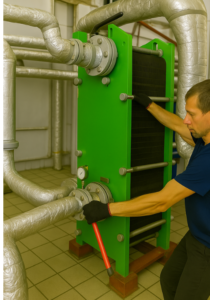
Even the most advanced heat recovery system will not work without proper design. In ventilation, aerodynamics and acoustics are calculated; in industry — hydraulics, thermodynamics, and connection to refrigeration circuits. At dairy and brewing plants, this involves selecting a plate heat exchanger, CIP cleaning system, and compressor protection automation. In residential buildings — duct routing, soundproofing, and space for equipment.
Installation is important everywhere: tightness, thermal insulation, and proper drainage. For plate cassettes, slopes and insulation are critical; for rotors — accessibility for maintenance. In the food industry, additional factors include bypass piping, domestic hot water temperature control, and protection of pumps and fittings. Typical errors include leakage due to poor sealing, reversed flows, absence of bypass, drainage without a trap, and excessive flow rates through plates. All these reduce efficiency and increase costs.
 Operation and maintenance of recuperators
In apartments, the first barrier is ISO 16890 filters; in the dairy industry, it is the cleanliness of the plate heat exchanger. Filter replacement or CIP cleaning of the heat exchanger is directly related to energy consumption and product quality. Signs of problems include increased noise, reduced performance, odors, or decreased cooling temperature.
Diagnostics include checking flow balance, bypass operation, the condition of the heat exchanger, and drainage. In industrial systems, pumps, desuperheaters, and domestic hot water temperature control are also monitored. Service life depends on materials: stainless steel and high-quality gaskets last for decades with proper maintenance, while fans or bearings require scheduled replacement.
How to choose a heat recuperator for home or business
Selection always starts with the task. For an apartment, it is important to consider noise, filters, the presence of a bypass, and actual efficiency. For a business — the type of heat exchanger, material resistance to the medium, accessibility of service zones, and integration with refrigeration systems. In older buildings, local ventilators with heat recovery or compact duct HRVs are used; in the food industry — plate and tubular heat exchangers made of stainless steel AISI 316L.
Tip: confirm efficiency only through ASHRAE/AHRI testing and ISO standards. Then the heat recovery system will be both economical and safe.
Tips from Teplo-Polis specialists
If it’s about air-to-air heat recovery in apartments and offices:
- start with a quiet minimum — a compact HRV or ventilator in the bedroom,
- consider the noise level and presence of a bypass,
- choose an ERV for dry climates and plate systems for medical facilities,
- check efficiency according to AHRI/ASHRAE ratings.
If the task involves liquid media in the food industry:
- pay attention to materials (AISI 316L, titanium, EPDM gaskets),
- design the CIP cleaning system at the equipment selection stage,
- consider the possibility of recovering heat from refrigeration equipment for domestic hot water,
- record parameters such as temperature, pressure, and flow rate to monitor degradation accurately.
Main principle: the task comes first, then the model. With this approach, a heat recovery system will be durable and cost-effective both at home and in industrial applications.
Comparison with other ventilation systems
Heat recovery stands out compared to traditional solutions. A simple supply and exhaust ventilation system maintains air exchange but loses all exhaust energy. An air conditioner controls only temperature and humidity but does not address the issue of fresh air. Systems with heat recovery combine both approaches, saving energy and improving comfort. In industry, the same logic applies to liquids: direct “head-on” heating and cooling consume large amounts of energy, whereas heat recovery returns the heat to the cycle, reducing the load on boilers and refrigeration machines.
Supply and exhaust ventilation without heat recovery
Such a system provides air exchange, but all the exhaust energy is lost. In a cold climate, this results in higher heating bills; in a hot climate, it increases the load on air conditioners. For rooms with infrequent occupancy, this may be sufficient, but for permanent residences or offices, it is more rational to use a heat recovery system.
A similar situation occurs in industry: if milk or wort is cooled simply with cold water without heat recovery, all the heat is “dumped down the drain.” With a heat recovery system installed, a significant portion of the energy is returned to the process, reducing steam and cooling costs.
Both in buildings and in industrial facilities, direct solutions are convenient but, in the long run, lose to heat recovery in terms of total cost efficiency.
Use of air conditioners and climate systems
A split system recirculates air and partially controls humidity but does not solve the problem of CO₂ and odors. Therefore, air conditioning is often supplemented by a central system with heat recovery: compressor load is reduced, and air quality improves.
The same logic applies in the food industry: a refrigeration unit alone only cools, but without utilizing its condenser heat, that energy is lost. When heat recovery from refrigeration equipment is added, the heat is used to warm water or solutions, reducing boiler operation.
An air conditioner is about temperature; heat recovery is about saving and reusing energy. The greatest effect comes from their intelligent combination.
| Solution | Advantages | Disadvantages | Where applicable |
|---|---|---|---|
| Ventilation without heat recovery | Low CAPEX, simplicity | High heat losses, no savings | Auxiliary zones, infrequent use |
| Ventilation with heat recovery | Energy savings, comfort, stable humidity | Higher cost, requires maintenance | Residential and office spaces, schools, shopping centers |
| Air conditioning only | Temperature control, quick effect | No fresh air supply | Rooms with periodic ventilation |
| Hybrid: ERV/HRV + air conditioning | Best overall efficiency | Complex design and control | Modern energy-efficient buildings |
Heat recovery is an engineering approach that allows energy to be reused instead of wasted. In homes and offices, it means fresh air, lower bills, and compliance with energy standards. In the food industry, it means returning the heat from milk, wort, or oil to a new cycle and reducing steam and cooling costs. In both cases, the result is the same: resource savings, stable comfort, and predictable efficiency.
Toggle title
FAQ
Which heat recovery system is the best?
There is no universal answer. In the residential sector, a plate recuperator is used for strict hygiene, a rotary ERV for improved winter comfort, and a glycol loop for complex layouts. In the food industry, the optimal solutions are plate and tubular heat exchangers made of stainless steel, as well as heat recovery from refrigeration equipment.
What is the efficiency of heat recovery?
In real conditions, air-to-air systems recover 60–90% of heat depending on the configuration and climate. In liquid processes (milk, beer, oil), steam and cooling savings reach 30–50%. For accurate comparison, refer to AHRI 1060 ratings, ASHRAE 84 methods, and EHEDG/ISO sanitary standards.
What is the difference between a heat recovery system and a heat pump?
Heat recovery is the passive transfer of energy between air or liquid flows. A heat pump is an active device with a compressor that raises the temperature of the heat source and requires additional electricity.
Which is better — a recuperator or an air conditioner?
The comparison is incorrect: a recuperator saves energy and provides ventilation, while an air conditioner controls the temperature and humidity of recirculated air. The same logic applies in industry: the recuperator returns energy, and the refrigeration unit provides cooling. The maximum effect is achieved when they work together.
Where is it best to install a recuperator?
In residential buildings — where there is access for maintenance and insulated ducts. In apartments, ventilators with heat recovery are convenient; in houses — units installed in utility rooms. In the food industry, recuperators are integrated into pasteurization and cooling lines, as well as into heat recovery circuits from compressors.
Local ventilators for apartments — yes, provided that installation instructions and insulation requirements are followed. Centralized systems and industrial recuperators require proper design and professional installation: errors in hydraulics, balancing, or sanitary cleaning reduce efficiency and may affect product safety.
Last Updated on by Микола Фролкин
Last Updated on by Микола Фролкин