

The FREE FLOW heat exchanger is a wide-channel heat exchanger
In the modern world, heating and cooling of viscous high-viscosity media, as well as media containing solid inclusions (pulp, fibers, crystals, etc.), are becoming increasingly important.

Areas of application of plate wide-channel heat exchangers (Free Flow):
Due to their unique design features, they are used in a wide variety of industries where reliability, high performance and energy efficiency are required.
- Food industry.
As heaters for diffused, defected, and saturated juice in the sugar industry. For heating and cooling of stillage, mash, grain mash in the alcohol industry. As heaters and coolers for viscous media, as well as media containing solid particles, fibers, pulp, crystals, etc. Cooler for apple puree, tomato paste, tomato juice, juice with pulp, and so on. - Pulp and paper industry.
Wide-channel heat exchangers are used in the pulp and paper industry for: heat recovery from scrubber water in the bark drying plant, cooling of wastewater in the secondary raw material processing plant, cooling of wastewater from the bleaching plant/heat recovery, evaporation of wastewater from the bleaching plant, cooling of scrubber water in the MDF fiber drying plant/heat recovery, energy recovery from accumulator/steam blowdown tank, cooling of solution after black liquor washing, cooling of solution after black liquor washing, as white water coolers after the BM press, cooling of water used for wetting elements of the chopper machine. - In the oil industry.
Used as crude oil heaters, heaters for primary and auxiliary technological processes.
Free Flow wide-channel heat exchangers are indispensable in industries where viscous, contaminated or solids-containing media must be handled. Their versatility, reliability and energy efficiency make them the optimal choice for demanding heat transfer applications.
Wide-channel plate (FREE FLOW)
In the FREE FLOW heat exchanger, the plates are unusual. They differ from plates in a conventional plate heat exchanger. The corrugation direction in the wide-channel heat exchanger is P-shaped, while in the conventional heat exchanger, the corrugations resemble fir trees.
The gaskets in the Free Flow heat exchanger are quite wide and high. This prevents the plates from colliding with each other and thus prevents the formation of stagnant zones. The design of the plates and gaskets allows assembling a package with wide channels. Consequently, the FREE FLOW heat exchanger operates smoothly with media containing solid inclusions.
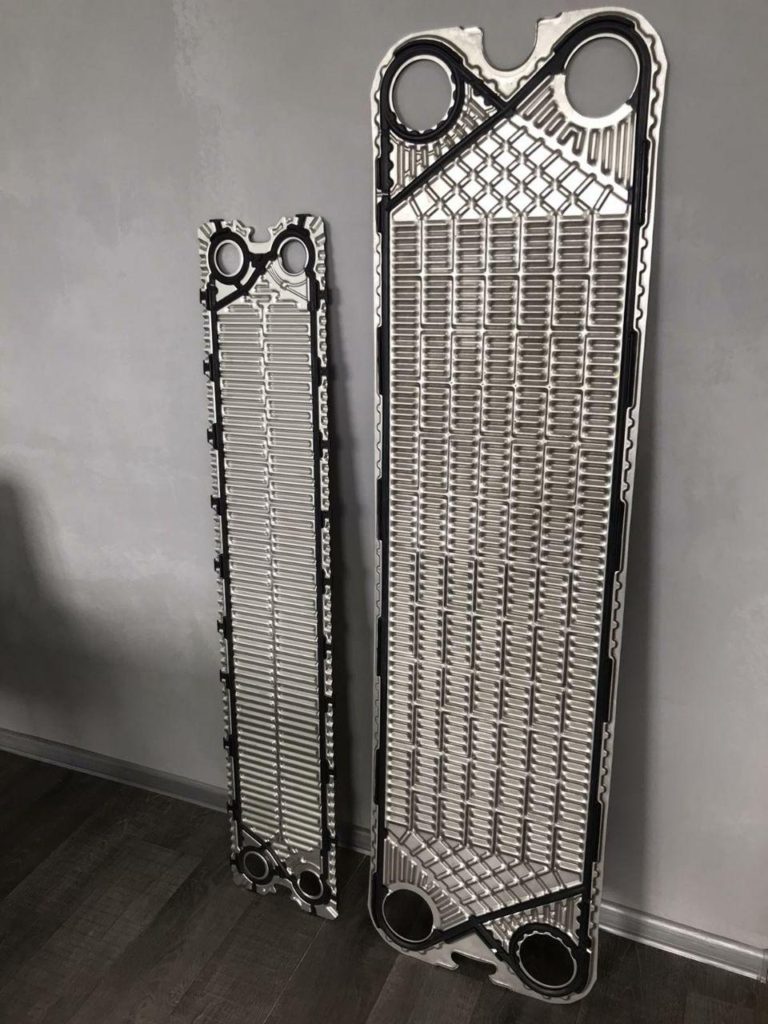
Advantages of wide-channel plate heat exchangers (Free Flow)
Free Flow wide channel plate heat exchangers are specially designed for demanding process applications. They ensure stable operation even under high loads and contaminated media.
Advantages:
- Channel width.Absence of metal-to-metal contact.Wide-channel plate heat exchanger it has specially designed open channels where there is no contact between the plates. Unlike a conventional plate heat exchanger, where the channel width varies from 0 mm to 8 mm, the wide-channel heat exchanger (FREE FLOW) has a minimum width of: 5.5 mm, 6.0 mm, 10 mm, 12 mm, and 20 mm. This type of channel allows the heat exchanger to continue working for a long time even if part of the channel is clogged.
- Absence of fouling. Free Flow heat exchangers have a wide channel (6-20 mm), allowing solid particles up to 5 mm in size to pass through.
- Easy on-site cleaning. Wide-channel heat exchangers have a dismountable design, allowing for easy disassembly and plate maintenance.
- Special plate attachment method that facilitates the installation of the plate pack after disassembling the heat exchanger or servicing it.
- The absence of “dead zones” on the plate allows the heat exchanger to operate efficiently and extends the time between technical maintenance of the heat exchangers.
- Increased periods of operation between scheduled maintenance and reduced time for heat exchanger servicing.
- High heat transfer coefficient.
- Compactness – wide-channel heat exchangers require less space for installation compared to spiral and tubular heat exchangers.
- Cost-effectiveness: Low cost and minimal operating and maintenance expenses.
The advantages of Free Flow wide-channel heat exchangers make them a versatile and reliable tool for optimizing heat transfer processes. It is a solution that not only helps to improve performance, but also to reduce maintenance and operating costs.
Cost of wide-channel heat exchangers
The price of a wide-channel heat exchanger depends on several factors that affect its technical characteristics and performance. The main parameters that determine the cost:
- Size and capacity: Heat exchanger size, heat transfer area and flow rate have a significant impact on price.
- Materials of construction: The use of materials such as stainless steel, titanium or alloys adapted to aggressive media can increase the cost.
- Customized requirements: If the heat exchanger is designed with a specific process in mind, the price will be affected.
- Equipment: Additional elements such as special seals or reinforced plates also affect the cost.
The company “Teplo-Polis” offers a wide range of models at competitive prices, providing delivery of equipment to any regions.
How to buy a wide-channel heat exchanger
Wide-channel heat exchangers TPSh are supplied on request. Please inquire about their cost and lead times from the company’s managers “Teplо-Polіs” by phone.
+38 (050) 432-75-80, +38 (050) 301-86-65, +38 (068) 301-86-65, +38 (073) 301-86-65
For the calculation of the price of a wide-channel heat exchanger, it is necessary to fill out questionnaire and send it to our address. After which the specialists of “Teplо-Polіs” will make a calculation with the minimum cost of the TPSh heat exchanger and the optimal compliance with the technical characteristics. You will be able to purchase a plate heat exchanger by placing Free Flow an order with us at the production facility.
Last Updated on by Микола Фролкин